
By J. Simpson
Editor’s note: The opinions expressed here are those of the authors. View more opinions on ScoonTV
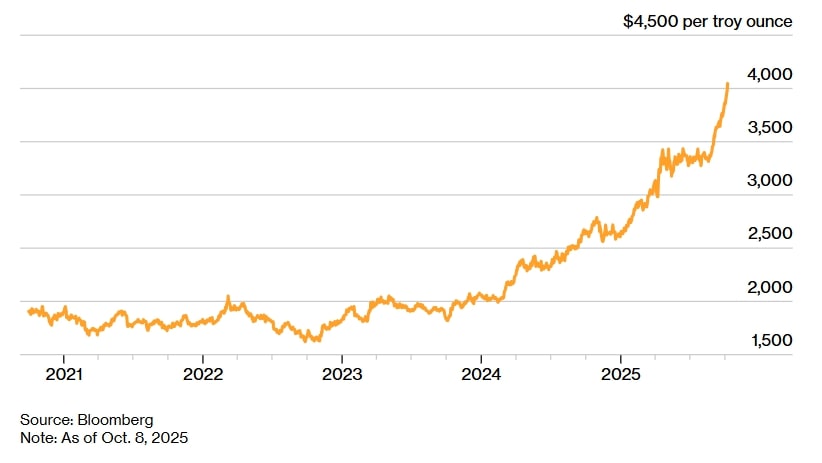
On October 8, 2025, gold shot up to $4,000 per troy ounce, the highest rate in known history. While the S&P also set new records, reaching record-breaking intraday and closing highs, the skyrocketing prices of precious metals tell a far different story. Investors don’t tend to put their money into precious metals when things are going well and they’re feeling confident in the future.
Consider the case of Craig Beauregard and Julia Edwards, a young couple profiled last year in the Wall Street Journal for buying a one-ounce gold bar at Costco as an investment. According to the Wall Street Journal, people are increasingly turning to precious metals to stave off instability. “Even people who aren’t building bunkers and predicting doomsday are increasingly preparing for worst-case scenarios. Natural disasters, wars in Ukraine and the Middle East, and the Covid-19 pandemic are fresh in the minds of many,” as they put it. Beauregard and Edwards told WSJ they were investing in gold and silver when rapid inflation started to undermine their faith in the American dollar.
Hyperinflation, collapsing currencies, bank closures, endless wars, and global pandemics… none of these things suggest an optimistic view of the future. The price of gold and other precious metals is not just a metric of wealth. It’s also a barometer of public sentiment. The record-setting highs of the price of gold suggest those sentiments aren’t as sunny as headlines might have you believe.
Why the Rising Price of Gold is a Cause for Alarm
Despite its steady value, gold is not an investment for the future. Unlike other investments like stocks or real estate, gold cannot easily be converted into cash flow. It is stable, but inert; a pure source of value and liquidity and little more. Think of it as storing cash beneath a mattress instead of in the bank. Not only does this prevent the assets from accumulating interest – one of the cornerstones of wealth generation – it’s a bad sign for banks, as well. Enough people hoarding their wealth as precious metals instead of investing in the economy could bring the whole system to a shuddering, grinding halt.
It also suggests a lack of faith that things will improve. Markets are always volatile and life is full of uncertainty, but the lack of faith in traditional investments and institutions, especially among younger generations, indicates that public trust has been badly broken, perhaps beyond repair, by the current system. Not only is the price of gold a useful metric to assess attitudes towards the future, it’s also a way to gauge how different generations see one another.
Millennials’ and Gen Z’s attitudes towards gold and other precious metals indicate some other recent economic trends as well as a generally gloomy outlook on the future. First, some are turning to gold because it’s trendy, earning big 32-point headlines as it breaks record after record. This suggests that the rise in the price of gold is driven less by a need for a stable currency should society happen to collapse and more by FOMO, with younger investors hoping not to miss out on another Bitcoin or Ethereum. This makes gold’s record-setting prices more like the next meme stock than preparation for the apocalypse.
Historical Precedents for the Soaring Price of Gold
Estimates that the rising price of gold indicates a pessimistic outlook don’t come from the void. Historically, a sudden spike in the price of gold can be mapped directly to times of upheaval.

The 1970s
As you can see from The Alloy Market, 1980 was the first time in the last 60 years that the price of gold skyrocketed. This is due to the economic chaos that started at the beginning of the 1970s and continued throughout the decade.
On August 15, 1971, Richard Nixon announced a new economic policy that would have serious economic repercussions. He announced that the United States Federal Reserve would no longer be backed by gold, in a bid to prevent hyperinflation and speculative gold rushes. Before 1971, people could demand that their currency be converted to its weight in gold. A decade of economic turmoil unfolded, nonetheless, capped by oil shortages, strikes, and stagflation as the decade stumbled to a close. The gold rush happened anyway in 1980, causing the first historic high.
2008–2011: Financial Crisis and the Flight to Safety
Our next data point comes from the first economic crisis of this century, when the collapse of the housing market, followed by the Great Recession, caused investors to abandon ship in droves in search of stable investments. While the price of gold didn’t skyrocket immediately, it reached a new peak in 2011 when even banks and hedge funds started investing in precious metals to help weather stormy economic waters.
2020 – 2021: The COVID Era
The last time the price of gold surged so dramatically was during the most dramatic upheaval of our lifetimes. The beginning of COVID saw investors frantically searching for anything tangible and secure as the world collapsed into uncertainty, fear, and despair. Not only did the price of gold spike in 2020 and 2021, but so did the demand for cash and consumer debt. There can be no better indication of how gold reflects the public’s unwillingness to invest in the future than times when it seems like there won’t be a future.
The Golden Rush
As we have seen, the demand for gold increases during times of great societal uncertainty. It suggests a lack of trust in established institutions and traditional financial advice. It indicates an inability to imagine where society, culture, and technology are heading in a way that the S&P isn’t able to, as stocks can be inflated by uncritical hype cycles and unethical investment practices.
Some of the rising demand for gold can be attributed to positive changes, such as it becoming easier for untrained investors to invest in gold without consulting a specialist, but this also presents its own challenges. Surely, there must be more to preparing for the future than dumping your life savings into questionable cryptocurrencies and meme stocks? The price of gold might as well be called the US Consumer Unconfidence Report. If these numbers are any indication, investors are feeling quite unconfident these days.
Curtis Scoon is the founder of ScoonTv.com Download the ScoonTv App to join our weekly livestream every Tuesday @ 8pm EST! Support true independent media. Become a VIP member www.scoontv.com/vip-signup/ and download the ScoonTv App from your App Store.